
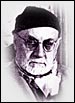
Henri Matisse Giclée Fine Art Prints 1 of 15
1869-1954
French Fauvist Painter
A box of paints, brought to a bedridden young law clerk by his mother in 1889, altered the course of twentieth-century art. Henri Emile Benoit Matisse, born on New Year's Eve 1869 in Le Cateau-Cambresis in northern France and dying in Nice on 3 November 1954, became the supreme colourist of the modern era - a painter, sculptor, draughtsman, and printmaker whose six-decade career reshaped the possibilities of pictorial expression.
Nothing in his origins predicted such a trajectory. Raised in Bohain-en-Vermandois in Picardy, the eldest son of a prosperous grain merchant, Matisse dutifully studied law in Paris and returned home to work as a court administrator. Then came the appendicitis, the convalescence, the art supplies. He later described painting as discovering "a kind of paradise." His father's disappointment never quite healed, yet by 1891 the young man was back in Paris, enrolled at the Academie Julian under William-Adolphe Bouguereau, then studying with the Symbolist Gustave Moreau at the Ecole Nationale des Beaux-Arts.
Early canvases reveal an artist of quiet competence, painting still lifes and landscapes in traditional manner. Matisse studied the old masters voraciously - copying Chardin at the Louvre, absorbing the compositional discipline of Poussin. A pivotal encounter came in 1896, when he visited the Australian painter John Russell on Belle Ile off the Breton coast. Russell, who had known Van Gogh personally, gave Matisse a Van Gogh drawing and explained colour theory to him. Matisse later credited Russell as his true teacher. Almost overnight, the earthen palette gave way to something brighter. That same year, five paintings were accepted for the salon of the Societe Nationale des Beaux-Arts; the state purchased two.
Personal life and creative ambition intertwined. A daughter, Marguerite, had been born in 1894 to the model Caroline Joblau. In 1898, Matisse married Amelie Noellie Parayre, who would raise Marguerite alongside their sons Jean and Pierre. Both Amelie and Marguerite became recurring models. On Camille Pissarro's advice, Matisse travelled to London that year to study Turner, then to Corsica. Returning to Paris, he fell into the orbit of Albert Marquet and Andre Derain and began collecting works that fed his eye: a Rodin bust, a Gauguin painting, a Van Gogh drawing, and Cezanne's Three Bathers - a canvas whose structural logic became, by his own account, his deepest inspiration.
Between 1898 and 1904, he experimented restlessly. Divisionist brushwork, drawn from Paul Signac's theoretical writings, occupied him for several years. Financial crisis struck when Amelie's parents were implicated in the Humbert Affair of 1902, leaving Matisse as sole provider for seven dependents. His palette turned darker, his forms more sculptural. He completed The Slave in 1903, one of his earliest significant sculptures. A first solo show at Ambroise Vollard's gallery in 1904 drew little notice. Yet that summer, painting at Saint-Tropez with Signac and Henri-Edmond Cross, Matisse produced the neo-Impressionist high point Luxe, Calme et Volupte.
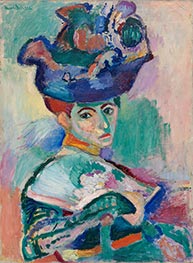
Everything changed in 1905. Working with Derain at Collioure, Matisse abandoned pointillism for flat, uninhibited colour in broad, autonomous zones. At the Salon d'Automne that October, paintings by Matisse and his circle - including The Open Window and Woman with a Hat - provoked fury and fascination. The critic Louis Vauxcelles, noting a classical sculpture amid these canvases of violent hue, coined the term "les Fauves" - the wild beasts. Camille Mauclair compared the effect to paint flung at the public. Yet when Gertrude and Leo Stein purchased the reviled Woman with a Hat, Matisse found not only buyers but champions whose salon would amplify his reputation across continents.
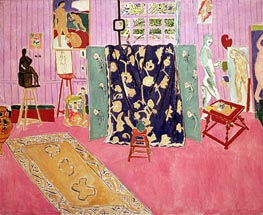
Fauvism as a movement proved short-lived, burning between 1904 and 1908, but its dissolution hardly slowed Matisse. Between 1906 and 1917, working amid the creative ferment of Montparnasse - though never quite belonging to its bohemian rhythms - he produced many of his most enduring paintings. Travel became a constant engine of renewal: Algeria in 1906 for African art and Primitivism; a major Islamic art exhibition in Munich in 1910, followed by months studying Moorish decoration in Spain; Morocco in 1912 and 1913, where black entered his palette as a full-bodied colour. The results pulse through L'Atelier Rouge of 1911, where saturated, unmodulated fields of colour flatten pictorial space into something both decorative and profoundly modern.
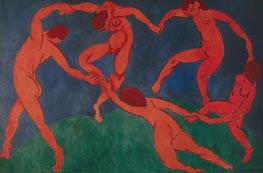
A transformative patron emerged in the Russian collector Sergei Shchukin, who in 1909 commissioned the monumental La Danse and its companion Music - works of radical simplification where rhythm, colour, and movement fuse into pure visual exhilaration. In 1917, Matisse relocated to the French Riviera, settling near Nice, where Mediterranean light suffused his interiors, odalisques, and still lifes with sensuous warmth. The 1920s brought wider acclaim and, paradoxically, charges from the avant-garde that he had grown conservative. Perhaps the sun-drenched rooms concealed the rigour beneath.
Renewal came spectacularly in 1930, when the American collector Albert C. Barnes commissioned an enormous mural for his foundation in Merion, Pennsylvania. La Danse, spanning some fourteen metres across three arched canvases, forced Matisse to work at an architectural scale he had never attempted. During the process he developed the technique of arranging cut painted paper shapes to plan compositions - a method that would prove prophetic. The 1930s also brought book illustrations for Skira and a journey to Tahiti, feeding a growing boldness in simplification.
War and illness defined the final chapter. Settled in southern France after 1940, Matisse underwent two major operations for duodenal cancer in 1941, leaving him largely confined to bed or wheelchair. Yet debility became liberation. Unable to stand at an easel, he turned to gouaches decoupees - painted paper cut-outs shaped with scissors and arranged with help from his devoted assistant Lydia Delectorskaya. Works such as Jazz (1947), The Swimming Pool (1952), and L'Escargot (1953) pulse with a chromatic intensity so fierce his doctor reportedly advised dark glasses. In these compositions, the scissor's edge defines contour and hue simultaneously.
One final project consumed him. Between 1948 and 1951, Matisse designed every element of the Chapelle du Rosaire in Vence - stained-glass windows, ceramic-tile murals, furnishings, even priestly vestments - for the Dominican nuns, inspired by his friendship with a former nurse, Monique Bourgeois, who had entered the order. A strange undertaking for a man who professed no religious belief. When Picasso teased him, suggesting he might as well decorate a brothel, Matisse reportedly replied: "Because nobody asked me." He called the chapel his culminating achievement. Three colours - yellow, green, blue - flood white walls with shifting light. It remains one of the most moving sacred spaces of the twentieth century.
Henri Matisse died of a heart attack on 3 November 1954 in Nice, aged eighty-four, and was buried at Cimiez. His legacy lies not merely in the paintings that hang in the Hermitage, the Museum of Modern Art, and the Barnes Foundation, nor in the museums bearing his name in Le Cateau-Cambresis and Nice. It persists in a fundamental proposition: that colour, liberated from the obligation to describe, can become the direct language of feeling. In an age of anxiety, that conviction - generous, sensual, stubbornly joyful - continues to offer what Matisse himself once sought: an art of balance and serenity, something like a good armchair in which the mind might rest.
Nothing in his origins predicted such a trajectory. Raised in Bohain-en-Vermandois in Picardy, the eldest son of a prosperous grain merchant, Matisse dutifully studied law in Paris and returned home to work as a court administrator. Then came the appendicitis, the convalescence, the art supplies. He later described painting as discovering "a kind of paradise." His father's disappointment never quite healed, yet by 1891 the young man was back in Paris, enrolled at the Academie Julian under William-Adolphe Bouguereau, then studying with the Symbolist Gustave Moreau at the Ecole Nationale des Beaux-Arts.
Early canvases reveal an artist of quiet competence, painting still lifes and landscapes in traditional manner. Matisse studied the old masters voraciously - copying Chardin at the Louvre, absorbing the compositional discipline of Poussin. A pivotal encounter came in 1896, when he visited the Australian painter John Russell on Belle Ile off the Breton coast. Russell, who had known Van Gogh personally, gave Matisse a Van Gogh drawing and explained colour theory to him. Matisse later credited Russell as his true teacher. Almost overnight, the earthen palette gave way to something brighter. That same year, five paintings were accepted for the salon of the Societe Nationale des Beaux-Arts; the state purchased two.
Personal life and creative ambition intertwined. A daughter, Marguerite, had been born in 1894 to the model Caroline Joblau. In 1898, Matisse married Amelie Noellie Parayre, who would raise Marguerite alongside their sons Jean and Pierre. Both Amelie and Marguerite became recurring models. On Camille Pissarro's advice, Matisse travelled to London that year to study Turner, then to Corsica. Returning to Paris, he fell into the orbit of Albert Marquet and Andre Derain and began collecting works that fed his eye: a Rodin bust, a Gauguin painting, a Van Gogh drawing, and Cezanne's Three Bathers - a canvas whose structural logic became, by his own account, his deepest inspiration.
Between 1898 and 1904, he experimented restlessly. Divisionist brushwork, drawn from Paul Signac's theoretical writings, occupied him for several years. Financial crisis struck when Amelie's parents were implicated in the Humbert Affair of 1902, leaving Matisse as sole provider for seven dependents. His palette turned darker, his forms more sculptural. He completed The Slave in 1903, one of his earliest significant sculptures. A first solo show at Ambroise Vollard's gallery in 1904 drew little notice. Yet that summer, painting at Saint-Tropez with Signac and Henri-Edmond Cross, Matisse produced the neo-Impressionist high point Luxe, Calme et Volupte.
Everything changed in 1905. Working with Derain at Collioure, Matisse abandoned pointillism for flat, uninhibited colour in broad, autonomous zones. At the Salon d'Automne that October, paintings by Matisse and his circle - including The Open Window and Woman with a Hat - provoked fury and fascination. The critic Louis Vauxcelles, noting a classical sculpture amid these canvases of violent hue, coined the term "les Fauves" - the wild beasts. Camille Mauclair compared the effect to paint flung at the public. Yet when Gertrude and Leo Stein purchased the reviled Woman with a Hat, Matisse found not only buyers but champions whose salon would amplify his reputation across continents.
Fauvism as a movement proved short-lived, burning between 1904 and 1908, but its dissolution hardly slowed Matisse. Between 1906 and 1917, working amid the creative ferment of Montparnasse - though never quite belonging to its bohemian rhythms - he produced many of his most enduring paintings. Travel became a constant engine of renewal: Algeria in 1906 for African art and Primitivism; a major Islamic art exhibition in Munich in 1910, followed by months studying Moorish decoration in Spain; Morocco in 1912 and 1913, where black entered his palette as a full-bodied colour. The results pulse through L'Atelier Rouge of 1911, where saturated, unmodulated fields of colour flatten pictorial space into something both decorative and profoundly modern.
A transformative patron emerged in the Russian collector Sergei Shchukin, who in 1909 commissioned the monumental La Danse and its companion Music - works of radical simplification where rhythm, colour, and movement fuse into pure visual exhilaration. In 1917, Matisse relocated to the French Riviera, settling near Nice, where Mediterranean light suffused his interiors, odalisques, and still lifes with sensuous warmth. The 1920s brought wider acclaim and, paradoxically, charges from the avant-garde that he had grown conservative. Perhaps the sun-drenched rooms concealed the rigour beneath.
Renewal came spectacularly in 1930, when the American collector Albert C. Barnes commissioned an enormous mural for his foundation in Merion, Pennsylvania. La Danse, spanning some fourteen metres across three arched canvases, forced Matisse to work at an architectural scale he had never attempted. During the process he developed the technique of arranging cut painted paper shapes to plan compositions - a method that would prove prophetic. The 1930s also brought book illustrations for Skira and a journey to Tahiti, feeding a growing boldness in simplification.
War and illness defined the final chapter. Settled in southern France after 1940, Matisse underwent two major operations for duodenal cancer in 1941, leaving him largely confined to bed or wheelchair. Yet debility became liberation. Unable to stand at an easel, he turned to gouaches decoupees - painted paper cut-outs shaped with scissors and arranged with help from his devoted assistant Lydia Delectorskaya. Works such as Jazz (1947), The Swimming Pool (1952), and L'Escargot (1953) pulse with a chromatic intensity so fierce his doctor reportedly advised dark glasses. In these compositions, the scissor's edge defines contour and hue simultaneously.
One final project consumed him. Between 1948 and 1951, Matisse designed every element of the Chapelle du Rosaire in Vence - stained-glass windows, ceramic-tile murals, furnishings, even priestly vestments - for the Dominican nuns, inspired by his friendship with a former nurse, Monique Bourgeois, who had entered the order. A strange undertaking for a man who professed no religious belief. When Picasso teased him, suggesting he might as well decorate a brothel, Matisse reportedly replied: "Because nobody asked me." He called the chapel his culminating achievement. Three colours - yellow, green, blue - flood white walls with shifting light. It remains one of the most moving sacred spaces of the twentieth century.
Henri Matisse died of a heart attack on 3 November 1954 in Nice, aged eighty-four, and was buried at Cimiez. His legacy lies not merely in the paintings that hang in the Hermitage, the Museum of Modern Art, and the Barnes Foundation, nor in the museums bearing his name in Le Cateau-Cambresis and Nice. It persists in a fundamental proposition: that colour, liberated from the obligation to describe, can become the direct language of feeling. In an age of anxiety, that conviction - generous, sensual, stubbornly joyful - continues to offer what Matisse himself once sought: an art of balance and serenity, something like a good armchair in which the mind might rest.
347 Matisse Artworks
Page 1 of 15
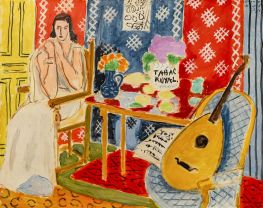
Giclée Canvas Print
$76.65
$76.65
SKU: 19910-MAT
Henri Matisse
Original Size:63.5 x 81.3 cm
Pinacoteca Agnelli, Torino, Italy
Henri Matisse
Original Size:63.5 x 81.3 cm
Pinacoteca Agnelli, Torino, Italy
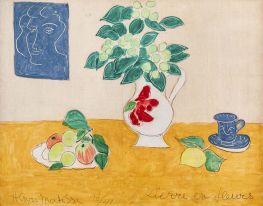
Giclée Canvas Print
$75.77
$75.77
SKU: 19909-MAT
Henri Matisse
Original Size:72.4 x 92.7 cm
Pinacoteca Agnelli, Torino, Italy
Henri Matisse
Original Size:72.4 x 92.7 cm
Pinacoteca Agnelli, Torino, Italy
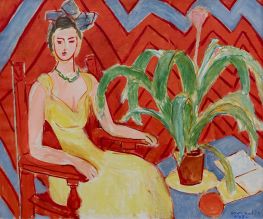
Giclée Canvas Print
$80.87
$80.87
SKU: 19911-MAT
Henri Matisse
Original Size:60 x 72 cm
Pinacoteca Agnelli, Torino, Italy
Henri Matisse
Original Size:60 x 72 cm
Pinacoteca Agnelli, Torino, Italy
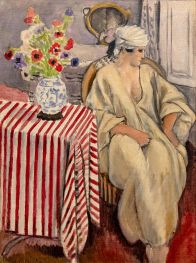
Giclée Canvas Print
$72.43
$72.43
SKU: 19907-MAT
Henri Matisse
Original Size:73 x 54 cm
Pinacoteca Agnelli, Torino, Italy
Henri Matisse
Original Size:73 x 54 cm
Pinacoteca Agnelli, Torino, Italy
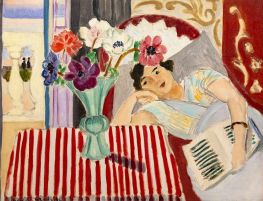
Giclée Canvas Print
$74.02
$74.02
SKU: 19908-MAT
Henri Matisse
Original Size:78.7 x 98.8 cm
Pinacoteca Agnelli, Torino, Italy
Henri Matisse
Original Size:78.7 x 98.8 cm
Pinacoteca Agnelli, Torino, Italy
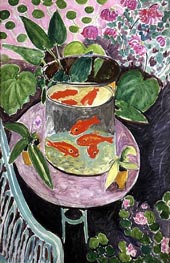
Giclée Canvas Print
$64.17
$64.17
SKU: 4798-MAT
Henri Matisse
Original Size:147 x 98 cm
Pushkin Museum of Fine Arts, Moscow, Russia
Henri Matisse
Original Size:147 x 98 cm
Pushkin Museum of Fine Arts, Moscow, Russia
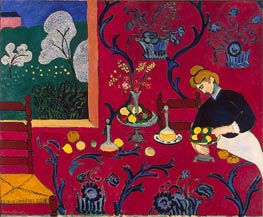
Giclée Canvas Print
$78.93
$78.93
SKU: 4775-MAT
Henri Matisse
Original Size:180 x 220 cm
Hermitage Museum, St. Petersburg, Russia
Henri Matisse
Original Size:180 x 220 cm
Hermitage Museum, St. Petersburg, Russia
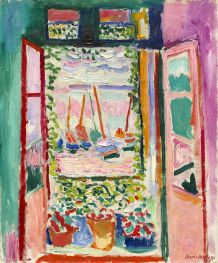
Giclée Canvas Print
$81.17
$81.17
SKU: 19606-MAT
Henri Matisse
Original Size:55.2 x 46 cm
National Gallery of Art, Washington, USA
Henri Matisse
Original Size:55.2 x 46 cm
National Gallery of Art, Washington, USA
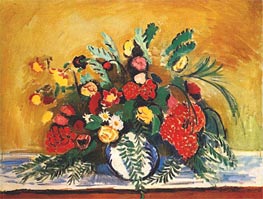
Giclée Canvas Print
$77.88
$77.88
SKU: 4825-MAT
Henri Matisse
Original Size:82 x 105 cm
Pushkin Museum of Fine Arts, Moscow, Russia
Henri Matisse
Original Size:82 x 105 cm
Pushkin Museum of Fine Arts, Moscow, Russia
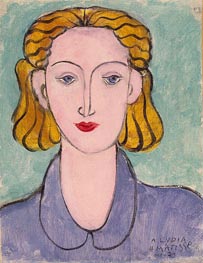
Giclée Canvas Print
$63.80
$63.80
SKU: 4797-MAT
Henri Matisse
Original Size:35.4 x 27.3 cm
Hermitage Museum, St. Petersburg, Russia
Henri Matisse
Original Size:35.4 x 27.3 cm
Hermitage Museum, St. Petersburg, Russia
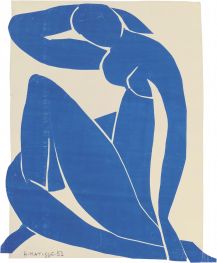
Giclée Canvas Print
$79.82
$79.82
SKU: 19310-MAT
Henri Matisse
Original Size:116.2 x 89 cm
Museum of Modern Art, New York, USA
Henri Matisse
Original Size:116.2 x 89 cm
Museum of Modern Art, New York, USA
Giclée Canvas Print
$64.00
$64.00
SKU: 4773-MAT
Henri Matisse
Original Size:260 x 391 cm
Hermitage Museum, St. Petersburg, Russia
Henri Matisse
Original Size:260 x 391 cm
Hermitage Museum, St. Petersburg, Russia
Giclée Canvas Print
$79.63
$79.63
SKU: 4806-MAT
Henri Matisse
Original Size:182 x 222 cm
Pushkin Museum of Fine Arts, Moscow, Russia
Henri Matisse
Original Size:182 x 222 cm
Pushkin Museum of Fine Arts, Moscow, Russia
Giclée Canvas Print
$76.30
$76.30
SKU: 4824-MAT
Henri Matisse
Original Size:65 x 81.5 cm
Pushkin Museum of Fine Arts, Moscow, Russia
Henri Matisse
Original Size:65 x 81.5 cm
Pushkin Museum of Fine Arts, Moscow, Russia
Giclée Canvas Print
$70.85
$70.85
SKU: 18955-MAT
Henri Matisse
Original Size:80.6 x 59.7 cm
San Francisco Museum of Modern Art, California, USA
Henri Matisse
Original Size:80.6 x 59.7 cm
San Francisco Museum of Modern Art, California, USA
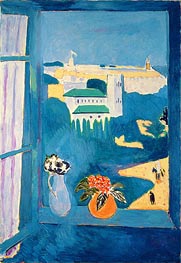
Giclée Canvas Print
$70.32
$70.32
SKU: 4801-MAT
Henri Matisse
Original Size:115 x 80 cm
Pushkin Museum of Fine Arts, Moscow, Russia
Henri Matisse
Original Size:115 x 80 cm
Pushkin Museum of Fine Arts, Moscow, Russia
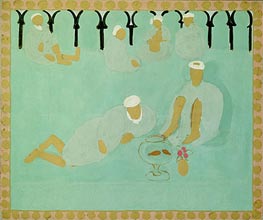
Giclée Canvas Print
$80.52
$80.52
SKU: 4772-MAT
Henri Matisse
Original Size:176 x 210 cm
Hermitage Museum, St. Petersburg, Russia
Henri Matisse
Original Size:176 x 210 cm
Hermitage Museum, St. Petersburg, Russia
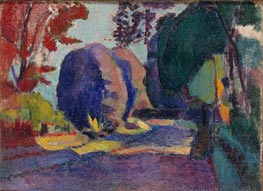
Giclée Canvas Print
$71.02
$71.02
SKU: 4794-MAT
Henri Matisse
Original Size:59.5 x 81.5 cm
Hermitage Museum, St. Petersburg, Russia
Henri Matisse
Original Size:59.5 x 81.5 cm
Hermitage Museum, St. Petersburg, Russia
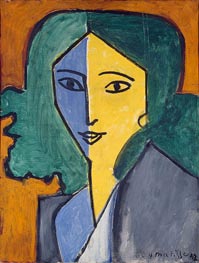
Giclée Canvas Print
$72.43
$72.43
SKU: 4796-MAT
Henri Matisse
Original Size:64.5 x 49.5 cm
Hermitage Museum, St. Petersburg, Russia
Henri Matisse
Original Size:64.5 x 49.5 cm
Hermitage Museum, St. Petersburg, Russia
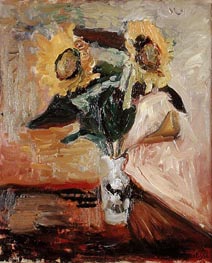
Giclée Canvas Print
$63.80
$63.80
SKU: 4815-MAT
Henri Matisse
Original Size:46 x 38 cm
Hermitage Museum, St. Petersburg, Russia
Henri Matisse
Original Size:46 x 38 cm
Hermitage Museum, St. Petersburg, Russia
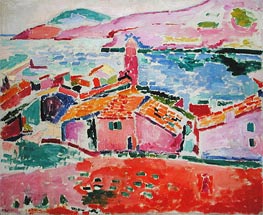
Giclée Canvas Print
$78.58
$78.58
SKU: 4822-MAT
Henri Matisse
Original Size:59.5 x 73 cm
Hermitage Museum, St. Petersburg, Russia
Henri Matisse
Original Size:59.5 x 73 cm
Hermitage Museum, St. Petersburg, Russia
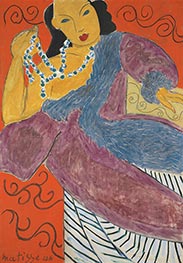
Giclée Canvas Print
$67.33
$67.33
SKU: 17593-MAT
Henri Matisse
Original Size:116.2 x 81.3 cm
Kimbell Art Museum, Fort Worth, USA
Henri Matisse
Original Size:116.2 x 81.3 cm
Kimbell Art Museum, Fort Worth, USA
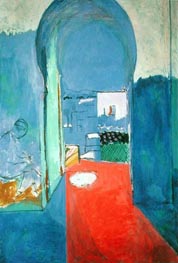
Giclée Canvas Print
$65.05
$65.05
SKU: 4803-MAT
Henri Matisse
Original Size:116 x 80 cm
Pushkin Museum of Fine Arts, Moscow, Russia
Henri Matisse
Original Size:116 x 80 cm
Pushkin Museum of Fine Arts, Moscow, Russia
Giclée Canvas Print
$81.74
$81.74
SKU: 4802-MAT
Henri Matisse
Original Size:115 x 100 cm
Pushkin Museum of Fine Arts, Moscow, Russia
Henri Matisse
Original Size:115 x 100 cm
Pushkin Museum of Fine Arts, Moscow, Russia