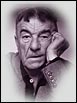
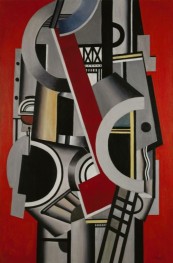
In the autumn of 1916, somewhere near Verdun, a French soldier barely survived a mustard gas attack. That soldier was Joseph Fernand Henri Leger (1881-1955), a Norman cattle farmer's son who would become one of the most distinctive painters of the twentieth century. A French artist whose vision fused the mechanical and the human, Leger carved out a singular path through Cubism, abstraction, and figuration - never quite belonging to any camp, yet reshaping each one he passed through.
Born on 4 February 1881 in Argentan, in the Orne department of Lower Normandy, Leger spent his earliest professional years at a drafting table, not before an easel. Between 1897 and 1899, he trained as an architect, and upon arriving in Paris in 1900, he earned his living as an architectural draftsman. Military service in Versailles occupied 1902 and 1903. He applied to the Ecole des Beaux-Arts and was refused - a rejection that scarcely slowed him. As a non-enrolled student, he studied under Gerome and others while working at the Academie Julian. By his own account, those were "three empty and useless years." Painting did not become his serious pursuit until around twenty-five, and his earliest surviving canvas, Le Jardin de ma mere (My Mother's Garden) of 1905, shows a young artist still absorbing impressionist atmospherics. Most other early works he destroyed.
A turning point arrived in 1907, when Leger encountered the Cezanne retrospective at the Salon d'Automne. Geometry and structure took precedence over atmosphere. Moving to Montparnasse in 1909, he entered the orbit of Alexander Archipenko, Jacques Lipchitz, Marc Chagall, Joseph Csaky, and Robert Delaunay - artists collectively reinventing the language of form. His major canvas of 1910, Nudes in the Forest (Nus dans la foret), now in the Kroeller-Mueller Museum in Otterlo, announced a personal dialect of Cubism built on robust cylindrical volumes rather than the angular faceting of Braque and Picasso. Critics called it "Tubism."
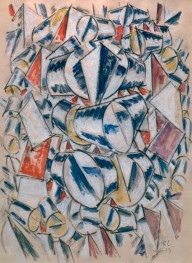
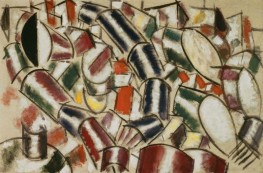
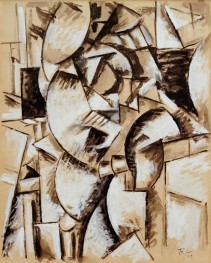
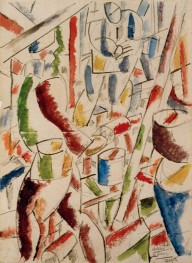
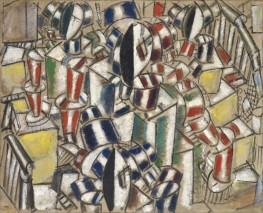
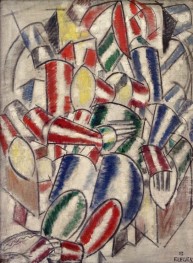
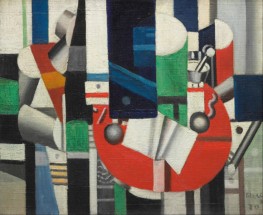
By 1911, Leger was exhibiting alongside Jean Metzinger, Albert Gleizes, Henri Le Fauconnier, and Delaunay at the Salon des Independants, presenting Cubism to the broader public as a coherent movement. The following year, he joined the Puteaux Group - also known as the Section d'Or - alongside Francis Picabia and the Duchamp brothers. Between 1912 and 1914, his paintings grew increasingly abstract: rough patches of primary colour plus green, black, and white rendered tubular and cubed forms with laconic precision, as in the Contrasting Forms series. Unlike Braque and Picasso, he never employed collage. Something almost stubbornly physical marked his method, a commitment to paint itself.
Then came the war. Mobilized in August 1914, Leger spent two years at the front in Argonne, sketching artillery and fellow soldiers. Soldier with a Pipe, painted during a furlough in 1916, captures the grim camaraderie of those months. After the gas attack at Verdun and a long convalescence in Villepinte, he produced The Card Players in 1917 - robot-like, almost monstrous figures that distilled the dehumanising reality of mechanized warfare. Leger recalled being "stunned by the sight of the breech of a 75 millimeter in the sunlight," and the crude vitality of the men around him made him want "to paint in slang with all its color and mobility." Perhaps the proximity of death sharpened his appetite for the concrete, the functional, the real.
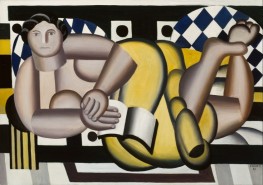
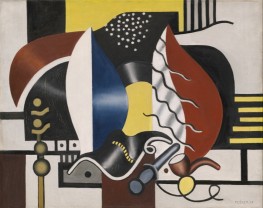
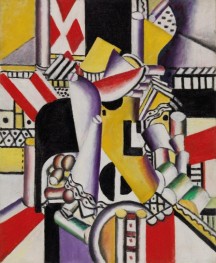
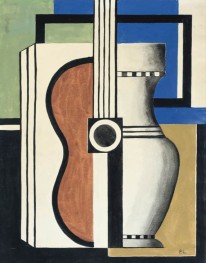
Out of this crucible emerged his "mechanical period." Sleekly rendered tubular forms and machine-like figures dominated his canvases from the late 1910s onward. In December 1919 he married Jeanne-Augustine Lohy, and the following year he met Le Corbusier, who became a lifelong friend. The 1920s saw Leger reconciling the classical with the modern: his paysages animes of 1921 present figures and animals in landscapes of streamlined forms, recalling Henri Rousseau's naive frontality. Nude on a Red Background of 1927 depicts a monumental, expressionless woman, machinelike in colour and contour. The Siphon of 1924, a still life derived from a Campari advertisement, marks the high point of Purist aesthetics in his oeuvre - balanced composition, fluted shapes suggestive of classical columns, a hand gripping a bottle in quasi-cinematic close-up.
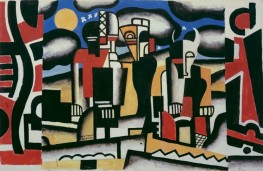
Cinema itself exerted a powerful pull. In 1923-24, Leger designed the laboratory set for Marcel L'Herbier's L'Inhumaine, and in 1924 he co-directed Ballet Mecanique with Dudley Murphy, in collaboration with George Antheil and Man Ray - a short film presenting lips, teeth, objects, and mechanical movements in hypnotic rhythm. Alongside Amedee Ozenfant, he founded the Academie Moderne, where he taught from 1924 with Alexandra Exter and Marie Laurencin. His first "mural paintings" appeared in 1925, conceived for polychrome architecture - flat areas of colour that advance and recede, among his most abstract compositions.
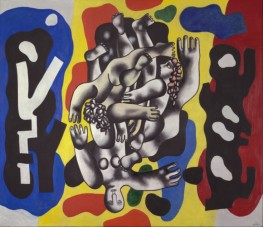
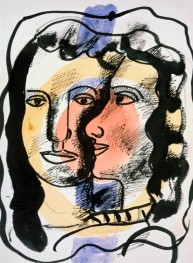
The 1930s brought gradual transformation. Organic and irregular forms gained ground, and the figural style that emerged shows fully in Two Sisters of 1935 and several versions of Adam and Eve - Adam wryly depicted in a striped bathing suit or sporting a tattoo. In 1931, Leger made his first visit to the United States, travelling to New York and Chicago. By 1935, the Museum of Modern Art mounted an exhibition of his work, and in 1938 Nelson Rockefeller commissioned him to decorate his apartment.
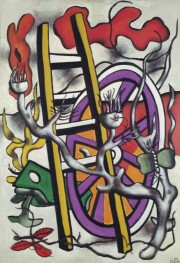
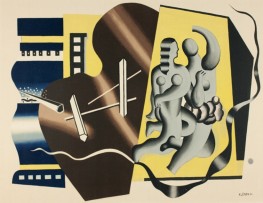
During the Second World War, Fernand Leger lived in the United States, teaching at Yale University and discovering fresh material in industrial refuse overgrown with wildflowers - what he termed the "law of contrast." Works such as The Tree in the Ladder (1943-44) and Romantic Landscape (1946) exploit these collisions. Broadway's neon lights offered another revelation: "You are there, you talk to someone, and all of a sudden he turns blue," he recalled, describing the freely arranged bands of colour juxtaposed with black-outlined figures that became a signature device.
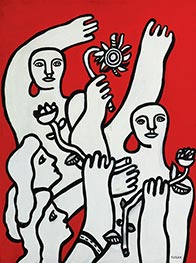
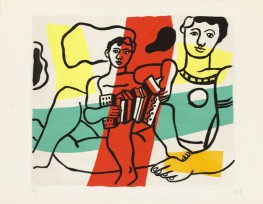
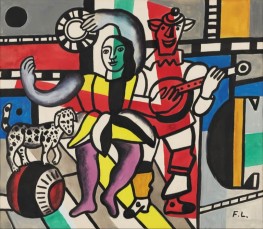
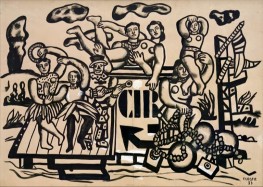
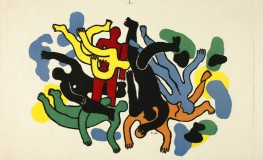
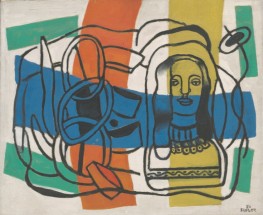
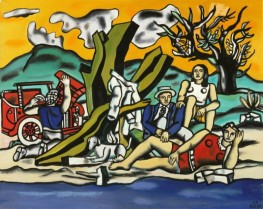
Returning to France in 1945, Leger joined the Communist Party. His art became less abstract, populated by monumental figures of acrobats, builders, and divers in scenes of popular life. Art historian Charlotta Kotik observed that his social conscience was not that of a fierce Marxist but of a passionate humanist. After Jeanne-Augustine Lohy's death in 1950, he married Nadia Khodossevitch in 1952. His final years were prodigiously varied: lectures in Bern, mosaics and stained-glass windows for the Central University of Venezuela in Caracas, and the series The Big Parade. In 1952, a pair of his murals was installed in the General Assembly Hall of the United Nations in New York. He began a mosaic for the Sao Paulo Opera in 1954 but did not live to complete it. Leger died suddenly on 17 August 1955 and is buried in Gif-sur-Yvette, Essonne.
Leger's reach extends well beyond his lifetime. A museum dedicated to his work opened in Biot, Alpes-Maritimes, in 1960. In 2008, his study for La Femme en Bleu sold for over thirty-nine million dollars. His pupils ranged from Louise Bourgeois and Sam Francis to Asger Jorn and Serge Gainsbourg - an astonishing breadth of influence. As the first painter to seize upon the imagery of the machine age and transform consumer objects into the subjects of art, Leger remains a convincing forerunner of Pop Art. His insistence that the human figure could function as a plastic value rather than a sentimental one still provokes and instructs. In a world saturated by manufactured images, his populist clarity speaks with undiminished force.